Ask a naval architect what decides the character of a ship, and the answer increasingly starts with power. How a vessel generates, stores and spends energy determines its layout, its weight, its operating profile and much of its cost. In the era of hybrid propulsion and strict emission limits, energy is no longer a system fitted into a finished hull — it is the decision around which the hull is drawn.
From One Engine to an Energy System
The classic arrangement was simple: one large diesel engine, one shaft, one propeller. It was efficient at its design point and inflexible everywhere else. Modern vessels, especially offshore support ships, ferries and special-purpose craft, rarely live at a single design point. They loiter, manoeuvre, hold position on dynamic positioning, sprint between ports and sit silent alongside — sometimes all in the same day.
That profile favours an energy-system approach: several smaller generator sets feeding an electrical grid, with propulsion motors, thrusters, cranes and hotel loads all drawing from the same pool. Capacity can be matched to demand hour by hour, engines run near their efficient sweet spot, and a single unit can be stopped for maintenance without stopping the ship.
Batteries Change the Arithmetic
Adding battery storage transforms that grid from a supply system into a managed resource. Batteries absorb peaks, so generator sets can be sized for average rather than maximum load. They provide silent, emission-free running in port and in environmentally sensitive areas, and they act as spinning reserve, allowing one fewer engine to run while keeping the safety margin regulators demand.
In practical ship design, those benefits must be weighed against weight, volume and cost. Battery rooms need fire protection, ventilation and structural integration, and their placement affects stability and trim. The naval architect’s job is to find the point where the operational savings and compliance gains comfortably outweigh the space the energy system occupies — space that could otherwise earn money as cargo or accommodation.
Power Management Is the Invisible Crew Member
Hardware alone does not deliver efficiency; control does. A modern power management system continuously decides which generators run, how load is shared, when batteries charge or discharge and how non-essential consumers are shed if a unit trips. On dynamically positioned vessels it works alongside the positioning system, predicting power demand from wind and current so the grid is ready before the thrusters ask.
Designers now simulate these interactions before steel is cut, testing failure cases on screen: What happens to the grid if the largest generator stops at the worst moment? Does the vessel stay safe, powered and in position? Answering those questions digitally is far cheaper than discovering the answers at sea.
Read Also: Revolutionizing cargo inspections with advanced scanning tech
Why Power Choices Echo Everywhere
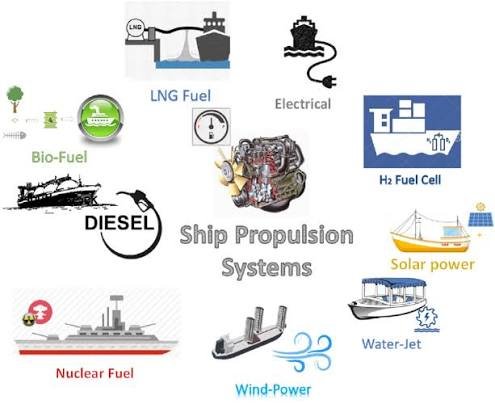
Choose a fuel and you choose tank shapes, safety zones, ventilation routes and crew training. Choose electric propulsion and you gain arrangement freedom — pods and distributed motors free the stern and the engine room — but inherit cable runs, switchboard rooms and cooling demands. Even the propeller is part of the energy conversation, since its diameter, speed and loading must match the motors or engines that drive it across the whole operating range, not just at full power.
That is why energy integration has moved to the front of the design process. Owners who decide their power philosophy early — conventional, hybrid, battery-assisted or fuel-flexible — give their designers a coherent brief. The result is a vessel whose hull, layout and systems pull in the same direction: toward lower fuel bills, cleaner operation and a ship that handles its real working day with power to spare.
Looking ahead, the trend is toward even tighter integration. Designers increasingly speak of the vessel as a floating microgrid, borrowing ideas from shore power engineering: renewable input where practical, storage as a normal component rather than an experiment, and software that treats every load as negotiable except safety. Offshore wind service vessels, with their mix of transit, positioning and hotel demand, have become the proving ground for these ideas, and the lessons are migrating steadily into ferries, research ships and cargo designs. The owners who benefit most will be those who brief energy performance with the same precision they apply to speed and capacity, because in the modern fleet, power is not a supporting system. It is the system around which the ship is organised.