

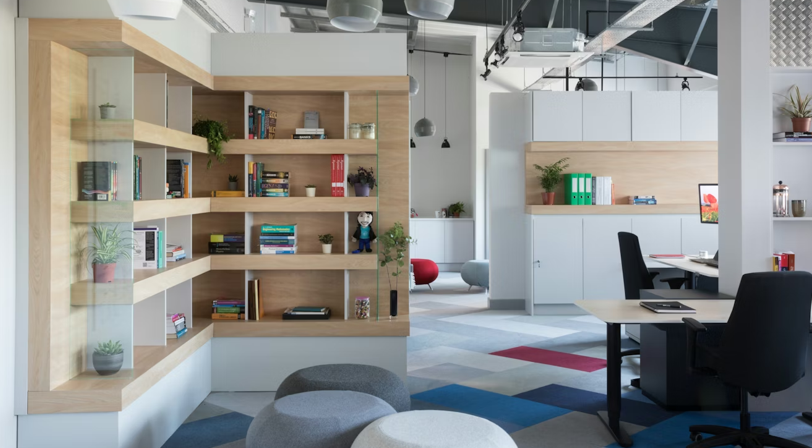
When designing a space, it’s important to think of now and in the future. We analyze a blueprint and label each square permanently as a living space, a dining space, or a bedroom. That is, until the reality of life gets in the way. We have families that grow, jobs that convert to telework, or hobbies that require a physical space that is different from the one before. If our buildings are not flexible, they will become outdated or require costly renovations.
This is where multi-functional design comes to play. By designing spaces that are centered on functionality and flexibility, one can create environments that grow with them. This is not only a money saver when it comes to future construction, it allows for a sustainable lifestyle where our footprint stays the same while our needs grow.
Applying Principles of Multi-Purpose Design
The philosophy behind adaptable design is to design for function rather than identity. We’re not trying to design a space for a ‘home office’ so much as designing a space for privacy, connectivity, and light. And those qualities make a space ideal for an office but also for a guest room or study or art studio.
Functional spaces which are successful incorporate the idea of a “loose fit.” When the professionals talk about this concept, they basically mean that the room should not be so specifically designed for a certain function that it cannot easily serve for other things. For instance, a kitchen with an island at the center can easily transition from a kitchen to a study area and even to a bar for cocktails in a matter of a few minutes.
Design Considerations for Flexible Space
Flexibility in the room involves much more than an open layout. Certain elements must be incorporated to enable the room to change moods momentarily. Lighting contributes greatly to these moods. A single light in the room indicates that the room is a utility room, and the use of various lights with dimmers enables a person to change the room from an office to a lounging area.
Another area of importance in making a house adaptable is storage. Clutter is the nemesis of adaptability because it ties a room to a particular function in the past. Built-in storage, where the pieces are incorporated along the wall and blend with it, enable people to stash away the accoutrements of a function in order to facilitate another one. On folding the desk back inside the cabinet, the office literally disappears, and the room starts afresh.
The selection of furniture is also essential. The presence of heavy furniture that cannot be moved influences the usage of a particular space. The presence of modular furniture or furniture that uses casters gives the owner the liberty to design the space. The use of sliding partitions or acoustic curtains also eliminates the need for walls. The space can be changed into private nooks if needed.
See also: Top Safety Mat Suppliers for Your Business
Future Trends in Multi-Purpose Space Design
In looking at the future of the construction industry, the materials we choose to use in constructing buildings would determine the degree to which we can adapt them. What we are seeing now is a movement towards structural designs where the use of interior bearing walls is no longer necessary. This is where the use of materials such as steel is so important. Steel has strength properties which enable it to support heavy loads without support columns, so there can be large shells designed in buildings which can be further divided or re-divided. They can also be used for premium steel riding arenas, for example.
Technology is also converging with the world of design to achieve “smart” flexibility. We find ourselves on the cusp of an era where smart systems will automatically control the lighting, the temperature, or even the walls themselves to respond to the time of day or voice commands. The buildings of the future will no longer be mere receptacles of the activities of humans, but will act as keen collaborators in these activities.
Make Long-Term Planning a Priority
Flexible design demands a paradigm shift in how we think about designing. It challenges us to stop thinking about what a room is and begin thinking about what a room could be. Through open-space planning, strategic storage, and the use of flexible materials such as steel, we can build a structure that lasts a lifetime. A flexible room is a resilient room that will be equipped to handle whatever life has to offer.



![[pii_email_617bc1605e831d66785f]](https://fusionpowertech.com/wp-content/uploads/2023/05/images-9-5.jpg)
![[pii_email_437f9945544e0f0f7028]](https://fusionpowertech.com/wp-content/uploads/2023/06/images-29-2.jpg)