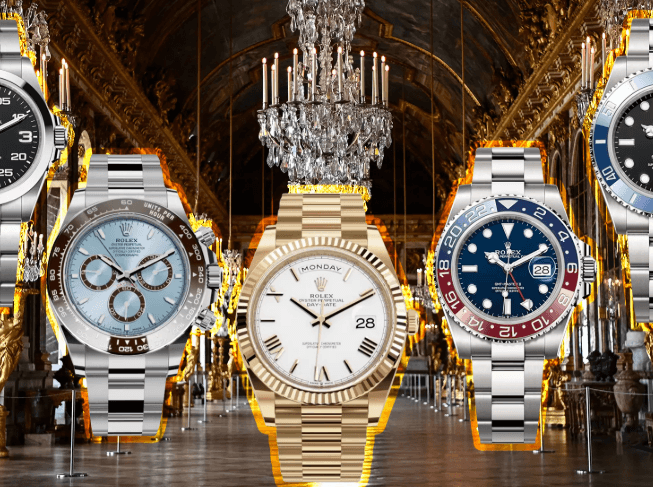
Rolex makes the decision feel straightforward until you actually try to make it. You know you want a sport reference. You have a budget in mind. But then you start researching, and suddenly the Submariner feels obvious, the GMT-Master II feels smarter, the Daytona feels aspirational, and the Explorer II and Sea-Dweller are making quiet, persuasive arguments of their own.
This is the part where most first-time buyers stall.
The five references covered here sit at the top of the secondary market for good reason. Each one has a distinct personality, a different value trajectory, and a different kind of wearability. Getting to know the differences between them, properly, is the fastest way to land on the right choice without second-guessing yourself six months later.
The Submariner: The Default for a Reason
The Submariner is where most conversations about Rolex sport watches start, and honestly, that is not without justification. It is the most recognisable watch Rolex makes. The rotating bezel, the Mercedes hands, the domed crystal, it all reads instantly. There is a reason so many other brands have spent decades referencing it.
The current references to know are the 124060 (no-date, black dial and bezel) and the 126610LN (date, black). There is also the 126610LV, the so-called “Starbucks” with its green and black bezel, which carries a healthy premium on the secondary market.
Secondary market availability: Relatively strong compared to harder-to-find references. You will not wait months to find a clean example.
Price trajectory: Submariner values softened through 2023 and into 2024 after the post-pandemic surge, which actually created a more rational entry point for buyers. The market has stabilised, and long-term appreciation on unworn or near-mint examples remains consistent.
Wearability: Exceptional. At 41mm with a relatively slim profile, the Submariner works across a genuinely wide range of situations. It does not demand attention. It just fits.
Best for: The buyer who wants a watch they will wear constantly, across nearly every context, without overthinking it.
The GMT-Master II: The Thinking Person’s Sport Watch
If the Submariner is the default, the GMT-Master II is the choice that rewards a little more thought. Originally designed for pilots and flight crews who needed to track two time zones simultaneously, it has evolved into something much more versatile than its original brief.
The bezel is the thing that separates the GMT variants and drives significant price differences. The “Pepsi” (126710BLRO, with its blue and red ceramic bezel) commands the highest secondary market premium. The “Batman” (126710BLNR, blue and black) sits slightly below it. The all-black “Sprite” (126720VTNF) is the newest addition and has already attracted strong collector interest, partly because it has a left-handed crown, which is a genuinely unusual detail for Rolex.
Secondary market availability: Moderate. Clean examples of the Pepsi especially are consistently in demand and take some searching to find at fair prices.
Price trajectory: Strong and consistent. The Pepsi has held value through market corrections better than many references because demand from both collectors and new buyers remains elevated.
Wearability: Slightly larger presence on the wrist than the Submariner, but still very wearable. The 40mm case with the colourful bezel means it does catch the eye more deliberately.
Best for: The buyer who travels, appreciates function alongside form, or simply wants a sport watch with a little more character on the dial.
The Explorer II: Underrated, Under-Bought, and Worth Considering
The Explorer II does not get the mainstream attention of the Submariner or GMT-Master II, which is, paradoxically, part of its appeal. It was designed for cave explorers and researchers working in environments where distinguishing AM from PM was genuinely important. The fixed 24-hour bezel and the large orange hand make it immediately functional in a way that feels purposeful rather than decorative.
The current reference is the 226570, available in white or black dial. The white dial version (sometimes called the “polar”) has a particularly strong following among collectors who appreciate cleaner aesthetics.
Secondary market availability: Better than most people expect. Because it has not reached the mainstream desirability of the Submariner, finding a well-priced example is more achievable.
Price trajectory: Steady. The Explorer II has not seen the same speculative run-up as the GMT-Master II or Daytona, which means it also has not experienced the same corrections. It is a measured, quietly appreciating reference.
Wearability: The 42mm case is the largest of the group, so wrist size matters here. On the right wrist, it is outstanding. It reads clearly and sits confidently without being aggressive.
Best for: The buyer who wants something distinctive, not immediately obvious to a casual observer, with strong appreciation potential and a legitimate design history behind it.
The Sea-Dweller: The Submariner’s More Serious Sibling
The Sea-Dweller sits between the Submariner and the Deepsea in Rolex’s dive watch hierarchy. It was developed for professional saturation divers, rated to 1,220 metres, and it incorporates a helium escape valve that most owners will never need to use. That does not diminish the appeal.
The current reference is the 126600, which reintroduced a date complication and notably brought back the cyclops lens after it was absent from the previous generation. It also carries the “Sea-Dweller” text in red on the dial, a nod to vintage references that collectors appreciate.
Secondary market availability: Good. The Sea-Dweller has a dedicated following but does not have the same broad consumer demand as the Submariner, which keeps availability reasonable.
Price trajectory: Stable, with a modest upward trend. Like the Explorer II, it has avoided the speculative peaks and valleys and tends to attract buyers who know exactly what they want.
Wearability: At 43mm, it is the thickest of the group due to its sapphire crystal and robust case construction. It is a watch you feel on the wrist. For buyers who appreciate that physicality, it is genuinely satisfying. For those who prefer something lighter, the Submariner is the better call.
Best for: The collector who wants a Rolex sport watch with serious technical credentials and a slightly more exclusive profile than the Submariner.
The Daytona: Collectibility at Its Most Extreme
The Daytona occupies a category of its own. Technically a chronograph designed for motorsport timing, it is consistently one of the most sought-after and talked-about references Rolex makes. Demand at authorised dealers is essentially impossible to satisfy through normal retail channels.
The current reference is the 126500LN (black ceramic bezel, launched in 2023), which replaced the long-running 116500LN. Both are highly collectible. The 126500LN introduced a new movement, the calibre 4132, with a column wheel and vertical clutch, and the updated case diameter sits at 40mm.
Secondary market availability: Tight, persistently. A clean, unworn 116500LN or 126500LN at a fair price takes real patience or access to the right network. Sources like Wrist Aficionado have built reputations specifically around sourcing high-demand references that buyers cannot find elsewhere.
Price trajectory: The Daytona has historically appreciated more aggressively than any other reference in this group. Even through market corrections, it has held a significant premium over retail. The 116500LN in particular has become a benchmark reference for secondary market tracking.
Wearability: Surprisingly wearable despite the dial complexity. The three-register chronograph layout is clean and balanced. It works as a daily wear watch even though many owners treat it as more of a collector’s piece.
Best for: The buyer whose budget stretches further and who values long-term collectibility above all else. This is the reference that tends to appreciate most reliably over time.
How Secondary Market Access Changes the Equation
One thing that does not get discussed enough in these comparisons is that all five of these references are effectively unavailable at retail for most buyers. Authorised dealers manage allocations carefully, and waitlists for the Daytona, GMT-Master II Pepsi, and Submariner LV can stretch to years with no guarantees.
The secondary market is not just an alternative. For most buyers, it is the only practical route. That means the quality of where you buy matters enormously. Authentication, condition representation, and fair pricing all have to be right, and that is where working with a reputable specialist makes a measurable difference.
For buyers who are also exploring other segments of the high-end watch market, it is worth knowing that the same rigorous authentication standards apply to other elite brands. If you are curious to shop Richard Mille watches online, the same principles apply: access, authentication, and condition transparency are the factors that separate a good purchase from a regrettable one.
Key Takeaways
- The Submariner is the most versatile daily wear option and the safest choice for a first-time buyer who wants one watch to do everything.
- The GMT-Master II Pepsi holds value consistently and rewards buyers who appreciate functional complication alongside strong aesthetics.
- The Explorer II and Sea-Dweller are underrated entry points for buyers who want something more distinctive with stable appreciation potential.
- The Daytona demands the highest investment but has the strongest long-term collectibility track record of the group.
- All five references are effectively unavailable at retail, so secondary market access and authentication quality are the most important practical considerations.
FAQ
Is the Submariner still worth buying at current secondary market prices? Yes, for most buyers. The price softening since 2022 has created a more rational entry point than existed at the market peak. A no-date 124060 in excellent condition offers strong long-term value and remains one of the most wearable watches at any price point.
Which Rolex sport watch holds its value best? The Daytona has historically shown the strongest appreciation among the five references, particularly steel chronograph references with ceramic bezels. The GMT-Master II Pepsi is a close second and is often easier to acquire at a fair price.
Does box and papers matter when buying on the secondary market? Significantly, yes. Full set examples, meaning original box and papers, can carry a premium of 10 to 20 percent or more depending on the reference. For the Daytona especially, papers confirmation of production year and authenticity adds real value and provides reassurance for future resale.
What size wrist suits which reference? The Submariner and GMT-Master II at 40 to 41mm suit most wrist sizes. The Explorer II at 42mm and Sea-Dweller at 43mm suit larger wrists better. The Daytona at 40mm is very balanced across wrist sizes. If you are uncertain, an in-person visit to a boutique that carries multiple references is worth the effort before committing.
Is it risky to buy a Rolex online without seeing it first? It depends entirely on the seller. Working with an established specialist that offers full authentication certification, detailed condition reporting, and insured shipping significantly reduces the risk. Buying privately without documentation is where buyers tend to get into trouble.
See also: Making Yourself The Ultimate Power Businesswoman
Conclusion
There is no bad choice in this group. The differences between these five references come down to personality, priorities, and how you actually plan to wear the watch. A traveller with an eye for detail will find the GMT-Master II endlessly satisfying. A buyer who wants pure, uncomplicated wearability will never regret the Submariner. Someone who values exclusivity and long-term collector value will always circle back to the Daytona.
The most useful thing you can do before committing is to get these watches on your wrist, even briefly, and to work with a source that can speak to condition, provenance, and pricing honestly. That combination of personal fit and informed buying is what separates a watch you love for decades from one you quietly move on from two years later.